|
|
|---|
Thursday, September 2, 2010
HUNTER S. THOMPSON
I can imagine few journalists working outside of motorcycle-industry 'rags', who have been as intimately connected to motorcycling as Hunter S. Thompson. The legendary writer invented a whole genre of reportage, 'Gonzo journalism', diving into his subject matter with such passion as to become a central figure in his own narrative. Writers before Thompson had lived with and identified with their subject matter, as he did in 'Hell's Angels: The Strange and Terrible Saga of the Outlaw Motorcycle Gangs' (Random House, 1966), but few admitted to and chronicled what exactly that meant - sex with designated 'mamas', Bacchic revelry around campfires and in seedy clubhouses, shooting and fighting. If you haven't read 'Hell's Angels', I highly recommend it, for while the club may have changed dramatically over the years, Thompson humanizes club members and lays out a sociopolitical context for their 'outsider' stance, and to his credit, never apologizes for or glosses over the worst of their behavior, or buys into their Romantic self image.
Thompson was a motorcyclist from his teens, as shown in the top photo from ca. 1963, on his stripped-down 1948 Triumph, a true California special. He had at least some affinity as a rider with the wild, bearded Outlaws who came to the attention of the press and the California Attorney General (Thomas C. Lynch - perfect name). Lynch submitted an official report on the gang in '65, blowing their influence, crime statistics, and numbers all out of proportion, perpetuating the image of a Bogeyman on two wheels, summoned dybbuk-like by Life magazine in their 1947 article on the Hollister 'riots', which formed the basis for the film 'The Wild One'. (For an education on this event, with witness interviews, click here)
(Photos by Hunter S. Thompson )
Lynch's report created another wave of popular mistrust of motorcyclists, and Thompson, living in San Francisco at the time (with a wife and child no less), spent two weeks visiting and interviewing HA gang members to get the 'real story', after gaining an introduction from ex-HA Birney Jarvis, a police reporter from the SF Chronicle. He quickly discredited Lynch's report, which claimed '233 active HA members in San Francisco alone' - Thompson found 11. It was a brave bit of reporting, not only to spend time with a gang who thoroughly distrusted journalists, but as well to throw all the rubbish, exaggeration, and fearmongering printed about the Hell's Angels right back at the Authorities and lapdog media. Thompson's article, 'The Motorcycle Gangs', was printed in The Nation in May 1965, and offers came immediately from publishers who wanted Thompson to expand the story.
Hunter S. Thompson spent the following year with the Angels, who fully participated in the project, recording lengthy interviews. Thompson's fair reporting in The Nation, combined with his riding skills, a measure of fearless crankiness, and a taste for bending his mind, earned the respect of the club. He also allowed club members to review drafts of the book for accuracy - probably a wise move, given their propensity for violence. Thus, his visits, interviews, and ultimately the book, were fully sanctioned by the club. That he was savagely 'stomped' at the end of his book is the stuff of legend, although he later admitted that those who beat him weren't HAs with whom he had spent time. Enjoy this sensationalizing television interview from shortly after the event (and you thought Jerry Springer et al were a novelty - this is 1966!):
The resultant book was a sales success, even though Thompson botched his book tour with continual drunkenness and erratic behavior. His writing career blossomed, and he continued to follow 'outsider' stories of drug use in the Haight-Ashbury district, and the media circus following political candidates.
In 1970, a 'small' assignment for Sports Illustrated (photographs of the Mint 400 motorcycle race with a 250-word caption), metastasized into a drug-fueled 2,500 word rant on his depraved Las Vegas trip with attorney Oscar Acosta (below).
While the magazine 'aggressively rejected' (!) his piece, Rolling Stone editor Jann Wenner liked what he read and commissioned a lengthy article, which appeared in two parts. 'Fear and Loathing in Las Vegas' (Random House, 1971) grew out of the articles, and in the midst of the druggy haze, a lot of hilarious writing about motorcycles is included. Here's a sample:
(Thompson also began a long collaboration with illustrator Ralph Steadman)
"Well," he said, "as your attorney I advise you to buy a motorcycle. How else can you cover a thing like this righteously?"
"No way," I said. "Where can we get hold of a Vincent Black Shadow?"
"Whats that?"
"A fantastic bike," I said. "The new model is something like two thousand cubic inches, developing two hundred brake-horsepower at four thousand revolutions per minute on a magnesium frame with two styrofoam seats and a total curb weight of exactly two hundred pounds."
"That sounds about right for this gig," he said.
"It is," I assured him. "The fucker's not much for turning, but it's pure hell on the straightaway. It'll outrun the F-111 until takeoff."
"Takeoff?" he said. "Can we handle that much torque?"
"Absolutely," I said. "I'll call New York for some cash."
And in 'Fear and Loathing on the Campaign Trail '72' (Random House, 1973):
After Miami the calendar shows a bit of rest on the political front -- but not for me: I have to come back out to California and ride that goddamn fiendish Vincent Black Shadow again, for the road tests. The original plan was to deal with the beast in my off-hours during the California primary coverage, but serious problems developed.
Ten days before the election -- with McGovern apparently so far ahead that most of the press people were looking for ways to avoid covering the final week -- I drove out to Ventura, a satellite town just north of L.A. in the San Fernando Valley, to pick up the bugger and use it to cover the rest of the primary. Greg Jackson, an ABC correspondent who used to race motorcycles, went along with me. We were both curious about this machine. Chris Bunche, editor of Choppers magazine, said it was so fast and terrible that it made the extremely fast Honda 750 seem like a harmless toy.
This proved to be absolutely true. I rode a factory-demo Honda for a while, just to get the feel of being back on a serious road-runner again . . . and it seemed just fine: very quick, very powerful, very easy in the hands, one-touch electric starter. A very civilized machine, in all, and I might even be tempted to buy one if I didn't have the same gut distaste for Hondas that the American Honda management has for Rolling Stone. They don't like the image. "You meet the nicest people on a Honda," they say -- but according to a letter from American Honda to the Rolling Stone ad manager, none of these nicest people have much stomach for a magazine like the Stone.
Which is probably just as well; because if you're a safe, happy, nice, young Republican you probably don't want to read about things like dope, rock music and politics anyway. You want to stick with Time, and for weekend recreation do a bit of the laid-back street-cruising on your big fast Honda 750. . . maybe burn a Sportster or a Triumph here or there, just for the fun of it: But nothing serious, because when you start that kind of thing you don't meet many nice people.
Jesus! Another tangent, and right up front, this time -- the whole lead, in fact, completely fucked.
His most legendary piece of motorcycle writing, though, on par in my opinion with T.E. Lawrence's extract from 'The Mint', is from an article in Cycle World, March 1995; 'The Song of the Sausage Creature' (read the entire piece here):
Of course. You want to cripple the bastard? Send him a 130-mph café racer. And include some license plates, so he'll think it's a streetbike. He's queer for anything fast.
Which is true. I have been a connoisseur of fast motorcycles all my life. I bought a brand-new 650 BSA Lightning when it was billed as "the fastest motorcycle ever tested by Hot Rod magazine." I have ridden a 500-pound Vincent through traffic on the Ventura Freeway with burning oil on my legs and run the Kawa 750 triple through Beverly Hills at night with a head full of acid.... I have ridden with Sonny Barger and smoked weed in biker bars with Jack Nicholson, Grace Slick, Ron Zigler, and my infamous old friend, Ken Kesey, a legendary Café Racer.
Or maybe not: The Ducati 900 is so finely engineered and balanced and torqued that you can do 90 mph in fifth through a 35-mph zone and get away with it. The bike is not just fast -- it is extremely quick and responsive, and it will do amazing things.... It is a little like riding the original Vincent Black Shadow, which would outrun an F-86 jet fighter on the takeoff runway, but at the end, the F-86 would go airborne and the Vincent would not, and there was no point in trying to turn it. WHAMO! The Sausage Creature strikes again.
There is a fundamental difference, however, between the old Vincents and the new breed of superbikes. If you rode the Black Shadow at top speed for any length of time, you would almost certainly die. That is why there are not many life members of the Vincent Black Shadow Society. The Vincent was like a bullet that went straight; the Ducati is like the magic bullet that went sideways and hit JFK and the Governor of Texas at the same time. It was impossible. But so was my terrifying sideways leap across railroad tracks on the 900SP. The bike did it easily with the grace of a fleeing tomcat. The landing was so easy I remember thinking, goddamnit, if I had screwed it on a little more I could have gone a lot further.
Maybe this is the new Café Racer macho. My bike is so much faster than yours that I dare you to ride it, you lame little turd. Do you have the balls to ride this BOTTOMLESS PIT OF TORQUE?
That is the attitude of the New Age superbike freak, and I am one of them. On some days they are about the most fun you can have with your clothes on. The Vincent just killed you a lot faster than a superbike will. A fool couldn't ride the Vincent Black Shadow more than once, but a fool can ride a Ducati 900 many times, and it will always be bloodcurdling kind of fun. That is the Curse of Speed which has plagued me all my life. I am a slave to it. On my tombstone they will carve, "IT NEVER GOT FAST ENOUGH FOR ME."
Thompson may have been light on technical data (surely for effect), but his adrenalized style really suits the experience of that special cocktail of Speed; half gonna-die danger, half gotta-live thrill.
Thursday, December 31, 2009
"AMENDE HONORABLE"

Amende Honorable, by 'R.B.'
"On the hill above Windsor, by the tower where Henry VIII made that splendidly practical protest at the price of meat, our sidecar outfit stopped owning to some trifling derangement. I ran her into the kerb, surrounded myself with the nebula of tobacco smoke which is so helpful to diagnosis, and fell to work with a wrench.
Vaguely I became conscious of a Presence, top-hatted and short-coated, aged possibly fourteen, moving in arcs about the side of my machine that faced the pavement, whose whistling implied a dearth of desert fruit (I'll not name them!).

Coldly he eyed my much-travelled sidecar, and then - brassily, provocatively, using our faithful 'bus's name - he said, 'Not much of a Royal!'[1] and cocked an eye to see what should follow.
This was new. Those several thousand miles a year take us by many public schools. Charterhouse has a keen eye for maker's transfers or the build of a tank; Harrow affects detachment, but will steal up and make diffident enquiry; Marlborough has a nice ear for exhaust notes; and the school Ardingly way has two who risked a late call-over to fetch me a spring link from the village (my appreciation, translatable into many tins of bloater-paste, was only reluctantly accepted). So I had hoped for better things from Eton.
Some cell in my brain, sealed these twenty years, opened, and I spoke to my passenger, honey-smooth.
'Strange,' I temporised, with the air of one whose withers are unwrung, 'Strange about Eton. Classic foundation, great name, many famous old boys. But' - I italicised darkly - 'there's something dreadful. You'd never believe it!'
Those pink ears twain under the black silk brim grew yet a shade pinker. Concealing a smile, my passenger played up nobly.
'Really?' she said, with just the right shade of polite surprise. 'I've always thought...' trailing away into nothingness, just like that.
I leaned forward, and spoke in a rattling whistper which the libeller could hardly miss: 'Their First Eleven bowl's under-arm!'[2]
'NO??!!' said Millie, registering horror.
'I've seen them,' as one who lets the truth be wrung from him.
Top-hat had gone the colour of a new cricket ball.
'Not the remove, mind you,' I added, judging him that high. 'The First E-le-ven!'
We let it go at that, but the silence while I put my tools away was more than eloquent. I saw his eye fall on our badge, the insignia of a public school motor cycling club which has a reputation, but not for sloth. His little heart was bursting to repel my foul insinuation, but pride and the memory of the fact that he had provoked the jousts forbade it.

I trod on Bucephalus's [3] kick-starter, and she burst into life with that exultant bellow which is all her own, descending on a control into a hollow mutter which suggests the confidences of a mastodon.
He came round into the road; he had to. Those impish blue eyes opened at the sight of our big, black iron lungs, and looked on interrogation almost wistful.
'Five Hundred Mile race type,' I explained, mercifully. 'One of LeVack's special jobs. Sixty easy.'
The look changed to positive reverence. 'I didn't mean,' he blurted, as the clutch snuggled home. 'Nor did we,' I laughed back at him.
'Floreat Aetona!' "
Notes!
[1]: Clearly, the reference is to a Royal Enfield v-twin of mid-20s vintage, as per the photo; the story is dated by reference later to Herbert LeVack as being from the late 1920s.
[2]: What follows is a dark discussion of Cricket, a game which is a complete mystery to me, but the meaning of the conversation is clear!
[3]: Alexander the Great's horse, Bucephalus, the stuff of legend for his strength, endurance, steadfastness in battle, and intelligence.
It was common for riders of Great Machines to name their motorcycles in the prewar era (in England at least). One thinks of T.E. Lawrence's Brough Superiors, named initially 'Boanerges' (the twin 'sons of thunder'), and later models 'George I-VII'.
In our age of disposable motorcycles, it's difficult to imagine the relationship which existed between man and motorcycle at that time. The beast needed the attention of its owner to give its best, then as now, a symbiosis which generated feelings of affection, and frustration or outright betrayal at times, when the old girl let you down.
You can really feel the Life in motorcycles from the Vintage era, with their smells, wheezes, sulks, coughs, 'petulant choofs', and mighty, inspiring roars when all is going well. A name is fitting.
Friday, December 25, 2009
'CASTOR': A GIANT AMONG MOTORCYCLE WRITERS
Last year I posted T.E. Lawrence's The Road (from' The Mint', read it here), which is essential reading for any Vintagent. Today's inclusion is from 'Castor' (Dennis May's nom de plume), of Motor Cycling magazine, August 17th, 1932.
I've included some notes at the bottom for 21st Century English translation, of items I couldn't find reference to on the Web!"Castor" bids a sorrowful GOOD BYE to the ULTRA FAST SIDECAR OUTFIT!
Below and without, dolls-housey from this seventh-storey window, stands a rank of many-specied vehicles. And at the end two cheap motorcycles.
One is a miniature-engiend pop-gun of 148cc. the other is the Brough Sup. Howitzer which you see at the head of this column emerging from a bitter-sweet murk of Castrol gas at nearly ninety-an-hour. It would cost you, as it stands, perhaps £180. and it would be cheap, because there exists, I imagine, nothing else at the price upon which you and the passenger of your choice could capture the same thrill of rapturous gusty speed.
These ultra-fast sidecar outfits are a dying race, it has seemed to me. The time was, seven, eight or more years ago, when they were a common sight along the roads: lean S.S. Hundreds of the late pre-chromium era, that sucked an exacting benzole blend through drain-pipe jets; now and then a bulbous, bold-fronted Flying Eight, clamped in rock-like unity to a T.T. Hughes [1] - all strutted and stayed like a mobile Sydney Bridge. Or perhaps it was a Replica Norton, with padded rear and near-side wings and the single's tuny beat, that left you wondering...and wishing, perhaps.
Where are they now, these Big Guns of the sidecar world? The answer, in the language of the telephone, is No Reply.
Perhaps, I thought, George Brough could tell me. Wrong again; he couldn't. But he would lend what his letter called a "highly tuned S.S.100," which Ron Storey [2], the fastest man on the sand, had cared for. Which left that friendly and resourceful sidecar trader, Maurice Wolston of Brixton Hill, to furnish a T.T. Hughes; and the human race at large to delegate a passenger.
This the human race accomplished easily, even if its representative was wont, as he said, to go to sleep in sidecars, and really I mustn't feel offended, etc., etc., etc.
Digressing, let me describe briefly the oufit as it stood at the setting out upon the most acutely wakeful ride in this passenger's career. One 8-55 long-stroke J.A.P. engine, with compression suited to a 50/50 mixture of Ethyl Special. Four-speed box, with tank-side gear-shift, the three high ratios close and the fourth nowhere. Eight-inch brakes fore, aft, and port. Three and a half gallon tank of Ethyl A, full measure, pressed down and almost running over.
Twin carbjectors [2]; throaty, vacant-sounding chaps, pleasant to hear. fixed at four firm points, one genuine Hughes basket, wherein basked one genuine human, to gallons spare Ethyl A, one quart spare Castrol "R", on gross British "Beech Nut" (permanent flavor - no, flavour).

Let's go!
Well, where? Fifty laps of Brooklands "road" course. Why not? For there, at least, there is nothing in the way.
Already I have tried to refuse the theory that these big huskies are the playthings only of the Very Rich. Developing that theme, I will deny that they are for the Idle. There is no pastime less idle, and few, therefore, more absorbing, than lasting high speed on 700lb. of sidecar outfit: this verily, is work for the Worker, with a Chekha-Ogpu-Ogpu! Vive le Kamerad Marx! [3]
* * *
At forty we are still in second gear - which please consider as bottom, and the box as a three-speed - merely warming up, hiccoughing asthmatically at every tenth beat or so. It is the noise of the twin calling for therms, which this afternoon, it happens, are scarce. Very well, little one, you shall have them in good time.
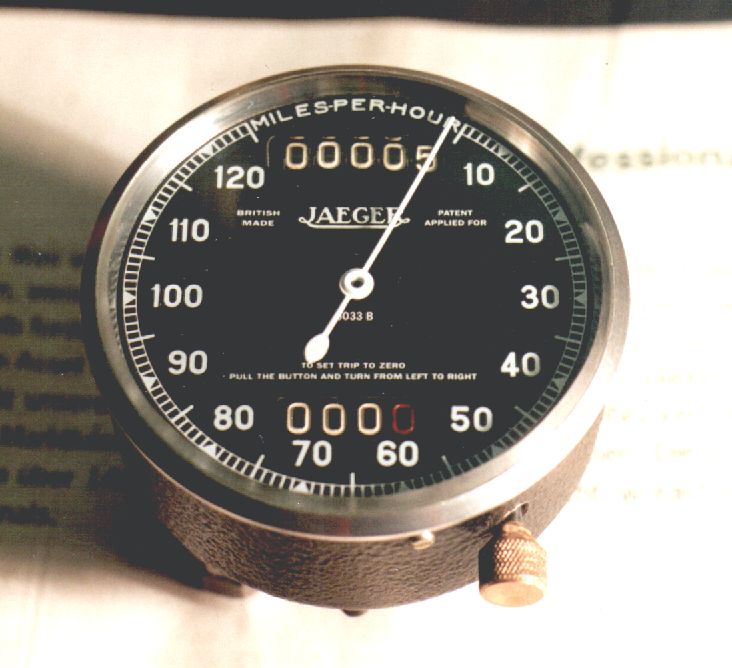
Presently, with two laps finished, the spitting becomes less frequent, until at length, with a last and petulant "choof" from the bell-mouth intake, like an obstinate child having the last word, she settles to it. Now the needle of the Jaeger meter is lying at a steady sixty; forward there by the tank nose the gear lever sits in the "third" position. Sixty in third - with the basket and basker aboard!
But this is not the end. From the motor's feel, peak revs. are yet a long way off. More work for the throttle wrist...round, and farther round comes the grip to its full-stop. simultaneously, the needle jerks on and up to sixty-five, sixty-eight, seventy. Still there are latent revs. in hand. Still there is power to spare. And still we are merely in third gear.
Seventy-two, three, three, three. Any advance on three? Going at three.....No, four. Seventy four. Now five. Seventy-five - and peak. A flick of the wrist and the throttle goes backwards half a turn. A downward and forward jab at that gear knob... as quickly back to the bar again for that remaining half a turn. TOP!
This is good. Which reminds me, I wonder how the Human Being's nap is going. I steal a glance back and left quickly, fearful of disturbing him. What, awake? Yes, and clinging to the handrail like a fury. Raging insomnia, I wouldn't wonder.
Meanwhile, the meter shows a sure enough eighty-two, which, I reflect, is as fast as I have driven sidecars - unless you count Lena the Killer [4]. So far, it is pleasant to ponder, the B.S. shows no signs of following in Lena's finger-prints...none of the homicide stuff.
Eighty-three, eighty-four. Still that busy little hand moves round, a symbol, in its jerky animation, to the blast of power which propels it on its course. Eighty-five. Eighty-six. Eighty-seven. Seven...seven. No increase on eighty-seven. Here and there the surface is indented with long waves and ripples, nothing much at 50 per, but telling a different tale at nearly 90. Hop, skip, jump. The front wheel leaves the track and comes down not quite straight. Follows a dither, in which bars swing hard to right and left, trying hard to shake these wrists away. Half-lock to half-lock.
This is fun. But it's work, Karl Marx, it's work.
That fine right-hand sweep at the Member's Bridge. Not a thing in sight; just concrete, and a nice grass verge at the top of the bank, if it should be necessary. A snick into third, both hands on the off-side bar, a heave... and a long steady twist. For a hundred yards, perhaps more, we can hear above the rumble at the rear that squeal that tells of concrete versus tyres. Judged, if I may say to, to a nicety. May I say so? I glance down again to H. Being, Esq., telepathically inquiring. No! No! NO! seems to be the message of his answering glower. Now he is a martyr, I feel sure, not really to wakefulness but to real alarm.
Next, a stop for plugs - pre-ignition, it seems.
"I say," he begins, "don't you think ---" "Fish out those H.45s,[5]" I manage to get in edgeways. "Quick. Thanks. No, I don't think." Three minutes' feverish work and a burnt finger, over which we will draw a veil. (And a finger-stall).
A rumble and she restarts, just in time to cut short another "I say..." Darn it, does the man want his motoring cellophane-wrapped, or what?
Right, right, right, go those never-ending corners. Always must there be a sufficient safety margin, yet never a second lost. Truly it is hard work taking that right-hand "Villa" hairpin with this big handful. First a heft prod at all three brakes as we approach the turn. Now harder on the rear wheel and simultaneously down a gear. The outfit answers our drag to port and reluctantly closes into the timing box, clear by the thickness of a shaving blade. Wallop! - on with the gas again just at the moment we're actually making the turn. Drive round corners - don't brake round them, which I resolutely maintain, is the whole are of basketry. Sidecaring, I mean.
But it's Work, I repeat. (Apologies. I won't say it again.)
It is a broken primary chain that comes between us and the fifty laps. And having been chaperoned through life by a racing man this primary chain has no spring link, but only rivets, continuous performance. Nice and strong, of course; but when it breaks...
* * *
Two hours passed before the welkin echoes to a gladsome "O.K., Chief," "Of course," says H.B., hopefully and (darn it!) with truth, "It's far too late now to finish schedule. Let's eat. And then let's just potter about the roads a bit."
We ate. And we rode many miles in the Surrey hills that day, ever regardful of safety, but setting some averages which made me glad that I was not alone, because two people's word are better than blank disbelief; and made H.B. profoundly sorry that I was not alone. How he hated me, the Brough, and Life! And how I loved all three!
From experience gained that afternoon I would say that with an outfit such as this 55 m.p.h. could be safely averaged ad nauseum on a main road like "A.1." No, I didn't say that I had done so. Far from me be it, to use a difficult phrase. Certainly it could, though.
Yesterday, as ever was, we had a strange experience, the Brough and I. We, "and friend," were taking a long steady rise in Surrey and , being all clear, were traveling fairly quickly. At the top those 700 pounds of iron and steel started to stand up on the back wheel. The front wheel didn't hop off the ground. I just climbed into space. When it reached, I'd say, a two-foot elevation, I remarked to phenomenon, and thinking that something was due to be done, turned the momentum off in haste. Otherwise - well, I wonder...
I still don't know why these big 'uns for two are a dying race. My ignorance is, indeed, aggravated. But that isn't George Brough's fault. Or that of Maurice Woolston, of Elm Park Road, Brixton. Nor yet the Human Race's, bless it. To these, my salutations!
NOTES:
[1]: The Hughes sidecar company made a T.T. racing model, which had a four-point fixing system to the motorcycle, and a tubular frame ringing the sidecar body at the front and rear of the sidecar chassis. Take a good look at the photos on this page; a subject for another post!
[2]: Legendary works tester for Brough Superior.
[3]: 'Carbjector' - the trade name for Brough Superior mufflers.
[4]: I find this a most curious phrase. By 1932, Josef Stalin had superseded V.I. Lenin as the Soviet Union's premier. His secret police agencies included the Cheka, and the O.G.P.U. - that 'Castor' should have used these acronyms for his 'work song' is cryptic, to say the least. They were as well-known as MI5 or the CIA are today; surely he knew exactly what was meant by his phrase, but vernacular usage of the day may have implied 'slave labor' - one of the darker aspects of the Soviet police state.
[5]:'Castor' famously tested 'Leaping Lena' for Motor Cycling (June 8, 1932); a streamlined Brough Superior sidecar outfit built up by Alan Bruce of Australia, which held the world sidecar record in 1932, at 124mph average. The record was taken at Neukirchner, near Vienna, and Bruce had copious help from Austrian Brough legend Eddy Meyer.
[6]: Lodge racing spark plugs; H45s were the 'coldest' plugs suitable for use with a 50/50 petrol/benzole fuel mix.
Monday, June 1, 2009
AN OBSERVATION ON VINTAGE MOTORCYCLING AND YOUTH CULTURE...
Did you get your Rex-Acme yet? I reluctantly gave Ewan McGregor his TT8 back, he seemed pleased with it. He was also very taken with my grubby old '35 Inter. I tell you, change is in the air; over here there seems to be an attitude shift, kids are as likely to give an old vehicle a thumbs up as catcalls. I feared that with bikes now principally the preserve of the over-40s, kids would view them like caravans and golf trolleys - but apparently not. Additionally there is much more interest in unrestored bikes and charm seems to score over concours shine, may be wishful thinking on my part but I had an interesting conversation with a friend my age at Stafford. He was keen on an unrestored New Imperial 500 ohv at £5000.
A very established collector friend scoffed at the price but Rob had the money and liked the bike. I didn't find out whether he bought it - but the point was the 'established collector' was ridiculed 15 years ago for paying 'stupid money' for a basket case SS100. Needless to say he has since sold it for a huge profit. Things change. The collector will have seen a not particularly special thirties bike, factored in the cost of painting, plating etc and decided that the price wasn't justified. But, Rob wouldn't want to restore it so these costs are immaterial and if, as I suspect, unrestored bikes are the future, that New Imp will have a value because of its condition, regardless of the provenance of the marque or model. I never really lusted after a cammy Norton but I bought mine simply because of its condition. When Ewan rode it he said, "If you ever find another one of these...in this condition and everything I mean..let me know"
Rick
(the photos were taken at the Coupe Moto Legende in Dijon, May 30/31, 2009, and show a broad age spectrum in attendance... hope for the future?)
Sunday, September 30, 2007
TE LAWRENCE - 'THE ROAD'

This short essay/reminiscence from T.E. Lawrence (of Arabia) is one of my favorite pieces of motorcycle writing. It's from his book 'The Mint', published posthumously in 1955. 'The Mint' is a collection of notes and essays penned by Lawrence while serving in the Royal Air Force (1923-35), and edited by his brother, Professor A.W. Lawrence, who inherited T.E.L.'s estate (and who had to sell the American rights to 'The Seven Pillars of Wisdom' to pay inheritance taxes in England on Lawrence's death in 1935, aged 46).
Lawrence gained his 'of Arabia' during the First World War, where his adoption of Arab dress, language, and custom gained him the respect of King Faisal, and convinced British brass to give T.E.L. a free hand to conduct commando raids on Turkish positions, using Arab tribesmen as his soldiers. After his rampant successes during the War (and promotion to Lieutenant-Colonel), he returned to England and sought the anonymity of enlisted military service to escape his fame, which partly resulted from cooperation with journalist Lowell Thomas during the Arab Campaign (Thomas sent frequent, romantic/heroic stories about Lawrence to the English press, and made him a hero). 'The Mint' chronicles those years spent in the RAF.
Lawrence published two original books during his lifetime; 'The Seven Pillars of Wisdom' (1926) and 'Revolt in the Desert' (1927), which was an abridged version of 'Seven Pillars'. Interestingly, Lawrence refused payment for his writing, feeling that he had already been paid by the government for his service in the military, on which the books were based. 'Revolt' was a best-seller, and profits went to a fund for children of RAF officers killed in action. If you're interested in reading his work, I'd suggest 'The Seven Pillars of Wisdom'; Lawrence had a natural gift for writing, and his dear friend George Bernard Shaw helped him edit the the book. It's a classic.
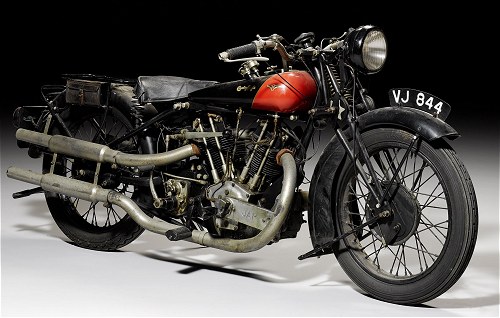
Of course, Lawrence writes here about his experience riding his Brough Superior S.S.100 model!.
The Road:
"The extravagance in which my surplus emotion expressed itself lay on the road. So long as roads were tarred blue and straight; not hedged; and empty and dry, so long I was rich.
Nightly I’d run up from the hangar, upon the last stroke of work, spurring my tired feet to be nimble. The very movement refreshed them, after the day-long restraint of service. In five minutes my bed would be down, ready for the night: in four more I was in breeches and puttees, pulling on my gauntlets as I walked over to my bike, which lived in a garage-hut, opposite. Its tyres never wanted air, its engine had a habit of starting at second kick: a good habit, for only by frantic plunges upon the starting pedal could my puny weight force the engine over the seven atmospheres of its compression.
Boanerges’ first glad roar at being alive again nightly jarred the huts of Cadet College into life. ‘There he goes, the noisy bugger,’ someone would say enviously in every flight. It is part of an airman’s profession to be knowing with engines: and a thoroughbred engine is our undying satisfaction. The camp wore the virtue of my Brough like a flower in its cap. Tonight Tug and Dusty came to the step of our hut to see me off. ‘Running down to Smoke, perhaps?’ jeered Dusty; hitting at my regular game of London and back for tea on fine Wednesday afternoons.
Boa is a top-gear machine, as sweet in that as most single-cylinders in middle. I chug lordlily past the guard-room and through the speed limit at no more than sixteen. Round the bend, past the farm, and the way straightens. Now for it. The engine’s final development is fifty-two horse-power. A miracle that all this docile strength waits behind one tiny lever for the pleasure of my hand.
Another bend: and I have the honour of one of England’ straightest and fastest roads. The burble of my exhaust unwound like a long cord behind me. Soon my speed snapped it, and I heard only the cry of the wind which my battering head split and fended aside. The cry rose with my speed to a shriek: while the air’s coldness streamed like two jets of iced water into my dissolving eyes. I screwed them to slits, and focused my sight two hundred yards ahead of me on the empty mosaic of the tar’s gravelled undulations..jpg)
Like arrows the tiny flies pricked my cheeks: and sometimes a heavier body, some house-fly or beetle, would crash into face or lips like a spent bullet. A glance at the speedometer: seventy-eight. Boanerges is warming up. I pull the throttle right open, on the top of the slope, and we swoop flying across the dip, and up-down up-down the switchback beyond: the weighty machine launching itself like a projectile with a whirr of wheels into the air at the take-off of each rise, to land lurchingly with such a snatch of the driving chain as jerks my spine like a rictus.
Once we so fled across the evening light, with the yellow sun on my left, when a huge shadow roared just overhead. A Bristol Fighter, from Whitewash Villas, our neighbour aerodrome, was banking sharply round. I checked speed an instant to wave: and the slip-stream of my impetus snapped my arm and elbow astern, like a raised flail. The pilot pointed down the road towards Lincoln. I sat hard in the saddle, folded back my ears and went away after him, like a dog after a hare. Quickly we drew abreast, as the impulse of his dive to my level exhausted itself.
The next mile of road was rough. I braced my feet into the rests, thrust with my arms, and clenched my knees on the tank till its rubber grips goggled under my thighs. Over the first pot-hole Boanerges screamed in surprise, its mud-guard bottoming with a yawp upon the tyre. Through the plunges of the next ten seconds I clung on, wedging my gloved hand in the throttle lever so that no bump should close it and spoil our speed. Then the bicycle wrenched sideways into three long ruts: it swayed dizzily, wagging its tail for thirty awful yards. Out came the clutch, the engine raced freely: Boa checked and straightened his head with a shake, as a Brough should.
The bad ground was passed and on the new road our flight became birdlike. My head was blown out with air so that my ears had failed and we seemed to whirl soundlessly between the sun-gilt stubble fields. I dared, on a rise, to slow imperceptibly and glance sideways into the sky. There the Bif was, two hundred yards and more back. Play with the fellow? Why not? I slowed to ninety: signalled with my hand for him to overtake. Slowed ten more: sat up. Over he rattled. His passenger, a helmeted and goggled grin, hung out of the cock-pit to pass me the ‘Up yer’ Raf randy greeting.
They were hoping I was a flash in the pan, giving them best. Open went my throttle again. Boa crept level, fifty feet below: held them: sailed ahead into the clean and lonely country. An approaching car pulled nearly into its ditch at the sight of our race. The Bif was zooming among the trees and telegraph poles, with my scurrying spot only eighty yards ahead. I gained though, gained steadily: was perhaps five miles an hour the faster. Down went my left hand to give the engine two extra dollops of oil, for fear that something was running hot: but an overhead Jap twin, super-tuned like this one, would carry on to the moon and back, unfaltering.
We drew near the settlement. A long mile before the first houses I closed down and coasted to the cross-roads by the hospital. Bif caught up, banked, climbed and turned for home, waving to me as long as he was in sight. Fourteen miles from camp, we are, here: and fifteen minutes since I left Tug and Dusty at the hut door.
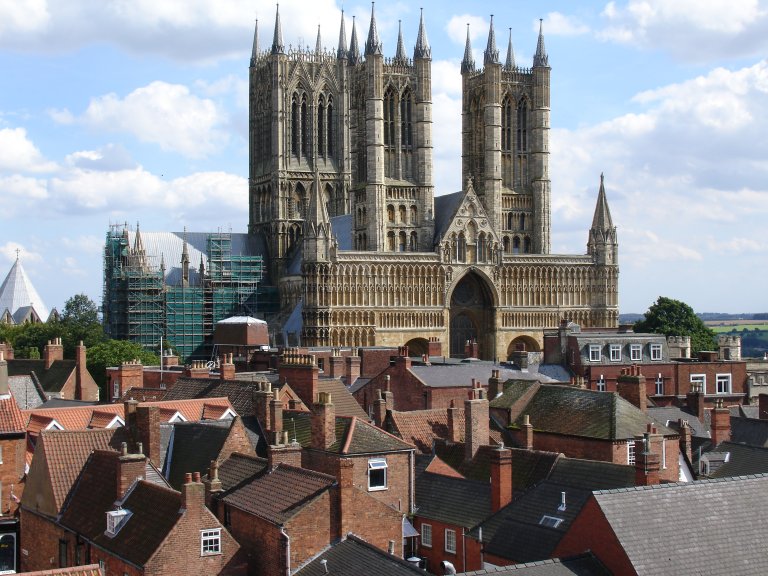
I let in the clutch again, and eased Boanerges down the hill along the tram-lines through the dirty streets and up-hill to the aloof cathedral, where it stood in frigid perfection above the cowering close. No message of mercy in Lincoln. Our God is a jealous God: and man’s very best offering will fall disdainfully short of worthiness, in the sight of Saint Hugh and his angels.
Remigius, earthy old Remigius, looks with more charity on and Boanerges. I stabled the steel magnificence of strength and speed at his west door and went in: to find the organist practising something slow and rhythmical, like a multiplication table in notes on the organ. The fretted, unsatisfying and unsatisfied lace-work of choir screen and spandrels drank in the main sound. Its surplus spilled thoughtfully into my ears.
By then my belly had forgotten its lunch, my eyes smarted and streamed. Out again, to sluice my head under the White Hart’s yard-pump. A cup of real chocolate and a muffin at the teashop: and Boa and I took the Newark road for the last hour of daylight. He ambles at forty-five and when roaring his utmost, surpasses the hundred. A skittish motor-bike with a touch of blood in it is better than all the riding animals on earth, because of its logical extension of our faculties, and the hint, the provocation, to excess conferred by its honeyed untiring smoothness. Because Boa loves me, he gives me five more miles of speed than a stranger would get from him.
At Nottingham I added sausages from my wholesaler to the bacon which I’d bought at Lincoln: bacon so nicely sliced that each rasher meant a penny. The solid pannier-bags behind the saddle took all this and at my next stop a (farm) took also a felt-hammocked box of fifteen eggs. Home by Sleaford, our squalid, purse-proud, local village. Its butcher had six penn’orth of dripping ready for me. For months have I been making my evening round a marketing, twice a week, riding a hundred miles for the joy of it and picking up the best food cheapest, over half the country side."